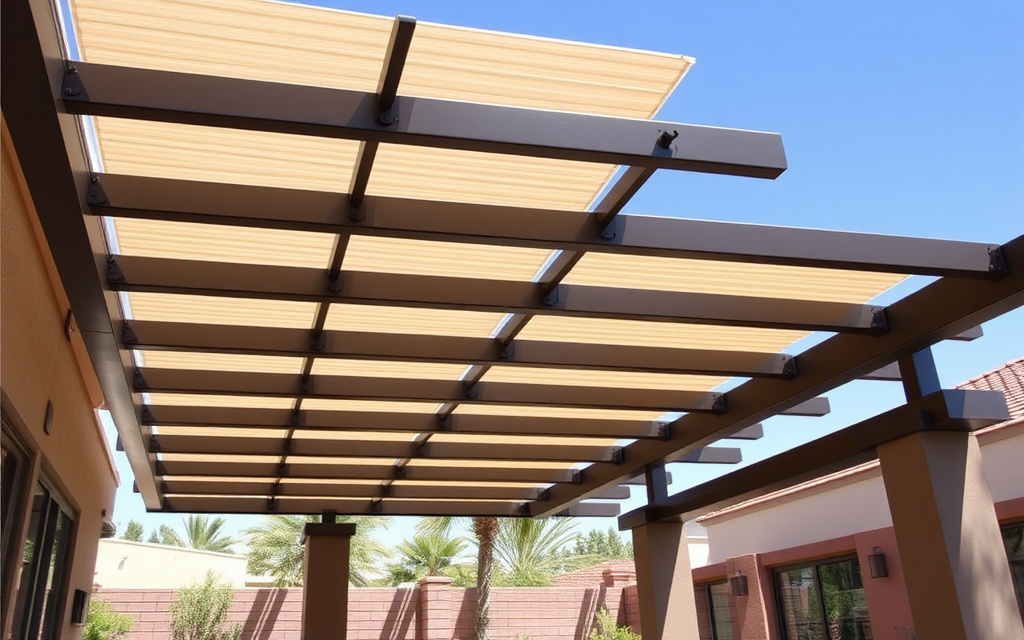
A traditional patio cover makes one decision for you permanently: full shade, all the time. That's great in July. It's less great on a perfect 72° December afternoon when you'd love a little sun on the patio. A louvered pergola Arizona homeowners are increasingly choosing solves that trade-off — it's one roof that adapts to every season instead of committing you to one setting forever.
Here's how adjustable and motorized louvered roofs actually work, what the rain sensors really do, and whether the motorized upgrade earns its keep in the East Valley.
What a Louvered Roof Is — and the Problem It Solves
A louvered roof is a pergola whose "slats" are pivoting aluminum blades instead of fixed rafters. Those blades rotate together, from fully open to fully closed, so you control exactly how much sun, shade, and airflow reaches your patio.
That single feature solves the core problem of a fixed cover in Arizona's split climate:
- Summer: Close the louvers to a near-solid roof and fully block the harsh midday sun. Angle them slightly and hot air still escapes upward while you stay shaded.
- Winter: Open the louvers and let the low winter sun warm the patio — turning an unused cold-season space back into usable square footage.
- Shoulder seasons: Dial in partial shade and cross-breeze for those perfect spring and fall evenings.
One roof, every season. That flexibility is why louvered systems have become the top-tier choice for outdoor living across Chandler and Gilbert.
How the Mechanism Works: Pivoting Blades
The engineering is simpler than it looks. Each aluminum blade sits on a pivot, and all the blades in a section are linked so they rotate in unison. Close them and the blade edges overlap into a near-continuous surface; open them and you get an open pergola with full sky and airflow.
You control that rotation one of three ways:
- Manual crank/gear. A hand crank rotates the linkage. Lowest cost, fewest parts, completely reliable — but you have to walk out and adjust it by hand.
- Motorized. A quiet electric motor drives the louvers. Tap a remote or wall switch and the roof opens or closes in seconds. This is what most East Valley homeowners choose because it's genuinely usable day to day.
- App / smart control. Motorized systems can add phone-app and voice control, plus automation — schedules, sun tracking, and rain sensors that act without you lifting a finger.
Motorization is also the gateway to the smart features below. If you want automation, you need a motor.
Rain Sensors and Auto-Close: What They Waterproof (and What They Don't)
This is the most important — and most oversold — part of any louvered pergola conversation, so we'll be straight with you.
A rain sensor detects the first moisture and automatically pivots the louvers closed. For a normal rain, a closed louvered roof sheds the vast majority of the water and keeps your patio dry. It's a genuinely useful feature, especially if you're not home when a storm rolls in.
But a louvered roof is weather-resistant, not fully sealed. Here's the monsoon reality:
- In a heavy monsoon downpour with wind-driven rain, some water can still weep through the seams where the blades meet.
- Blades closing on a windy day don't seal like a solid, welded roof does.
- To get closer to fully dry, the system needs an integrated gutter and track that channels water off the blade edges and down through the posts.
So set expectations correctly:
- Want highly weather-resistant with hands-off auto-close? A standard motorized louvered roof is excellent.
- Want a truly dry space that never lets a drop through? Add an integrated gutter/drainage track — or consider an insulated solid roof for that zone.
We'll tell you honestly which system matches your expectations before you buy, not after.
Add-Ons Worth Considering
The louvered frame is a platform. Because it's aluminum with a hollow structure, it's easy to integrate features cleanly:
- LED lighting. Recessed perimeter or in-beam LEDs run through the frame for ambient evening light with no exposed wiring.
- Motorized or fixed screens. Drop-down screens on the sides cut low-angle sun, add privacy, and keep bugs out — turning the space into a screened room on demand.
- Sun tracking. Motorized systems can automatically angle the blades to follow the sun through the day, maximizing shade without you touching anything.
- Integrated drainage. The gutter/track system mentioned above, built into the frame and posts.
- Fans and heaters. Ceiling fans for summer airflow and infrared heaters for winter extend usability across nearly the whole year in the East Valley.
Cost, Lead Time, and Is Motorized Worth It?
Louvered roofs are a top-tier product, and motorized systems cost meaningfully more than a standard solid cover of the same footprint. Here's a realistic breakdown of the trade-offs.
| Consideration | Manual Louvered | Motorized Louvered |
|---|---|---|
| Up-front cost | Lower | Higher |
| Everyday usability | Adjust by hand | Remote / app / automatic |
| Automation (rain sensor, sun tracking) | Not available | Available |
| Moving parts | Fewer | More (motor, sensors) |
| Typical lead time | Several weeks | ~6–8 weeks |
| Best for | Budget-minded, occasional adjustment | Daily-use patios, hands-off convenience |
A motorized louvered pergola typically runs on a 6–8 week lead time once design, engineering, and city approval are handled — longer than a standard cover because the components are made to order and the system is integrated on site.
Is motorized worth it in the East Valley? For most homeowners, yes. The whole value of a louvered roof is adjusting it to the season and the hour — and if adjusting means walking outside and cranking a handle, people stop doing it. A remote or automatic system means you actually use the flexibility you paid for. If budget is tight and you're disciplined about hand-cranking, manual is a legitimate, reliable choice. But the homeowners happiest with their louvered roofs almost always went motorized.
Frequently Asked Questions
Do motorized louvers keep rain out completely? They keep out the vast majority of a normal rain, and a rain sensor closes them automatically. But louvered roofs are weather-resistant, not fully sealed — in a heavy monsoon, some water can weep through the seams unless the system has an integrated gutter and track. Add drainage if you need a truly dry space.
How long does a motorized louvered pergola take to build? Expect roughly 6–8 weeks once permits and HOA approval are handled. The components are made to order and integrated on site, so the lead time is longer than a standard aluminum or Alumawood cover.
Can I control it from my phone? Yes. Motorized systems support remote, wall switch, and phone-app control, plus automation like scheduling, sun tracking, and rain-sensor auto-close. Manual louvered roofs are adjusted by hand crank and don't support these features.
Is a louvered roof cooler than a solid cover in summer? An insulated solid roof blocks the most radiant heat, but a louvered roof is a close second — you can close the blades to fully shade the midday sun while angling them just enough to let hot air escape upward, which a solid roof can't do.
See a Louvered Roof Designed for Your Patio
A louvered pergola is a big upgrade, and the right configuration — manual vs. motorized, screens, lighting, drainage — depends entirely on how you use your yard. That's what our free design consultation is for. We'll walk your space, show you how the blades and controls work in person, and give you a firm quote with honest expectations about the monsoon.
We design and build louvered pergolas across Chandler, Gilbert, Mesa, Queen Creek, and Tempe. Call 844-967-5247 to schedule your free consultation and start planning a roof that finally works in every season.