Louvered & Adjustable-Roof Pergolas in Chandler — Shade or Sun, at the Turn of a Dial
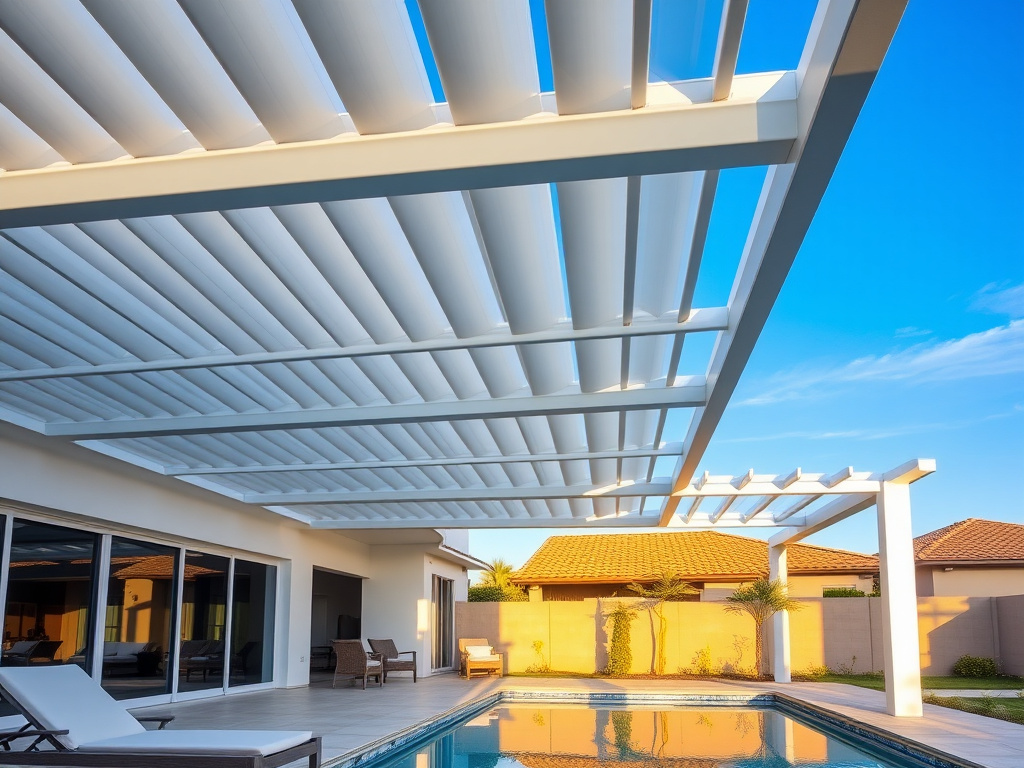
A louvered pergola gives you something no fixed roof can: shade you can dial in. Pivoting aluminum blades rotate from wide open for sun and breeze to fully closed for deep shade or light rain, so one structure works across every Arizona season. We build manual, motorized, and app-controlled systems with LED lighting, screens, and integrated drainage, engineered for the monsoon.
What's Included
- Pivoting powder-coated aluminum louver blades
- Manual, motorized or app and voice control
- Rain sensors with automatic close
- Integrated LED lighting and optional screens
- Gutter-track drainage built into the frame
- Engineered footings and motor system warranty
How adjustable louvered roofs work (pivoting aluminum blades)
A louvered roof solves the basic problem with every fixed shade structure: the sun is not in the same place in July as it is in January, but a solid roof or an open pergola gives you the same thing year round. A louvered roof does not.
The roof is made of aluminum blades, called louvers, that run in parallel across the frame and pivot on a track along their length. Rotate them one way and they open like window blinds, letting sun, sky, and breeze pour through the gaps. Rotate them the other way and they close until the edges overlap into a near-solid roof that throws deep, full shade and sheds light rain. Everything in between is available too, so you can leave them cracked at 45 degrees to cut the harsh sun while still venting hot air upward.
That adjustability is the whole appeal in a climate like ours. On a brutal July afternoon you close the louvers to block the sun completely and let the rising heat escape through the top. On a mild January day you open them fully to let the winter sun warm the patio. In spring and fall you split the difference. One roof, tuned to the day, instead of a compromise you live with all year.
The blades are powder-coated aluminum, so they carry the same rustproof, fade-resistant durability as our other covers, and the pivoting mechanism is built to cycle open and closed for years. Whether you turn them by hand or by motor is the next decision.
Manual vs. motorized vs. app and voice control
Louvered roofs come in three control levels, and the right one depends on how you will use the patio and your budget.
Manual louvers adjust with a hand crank or a gear mechanism. They cost the least, have the fewest parts to ever service, and do everything a louvered roof is supposed to do. The catch is friction: if adjusting the shade means walking out and cranking every time the sun moves, a lot of people simply stop bothering and leave it in one position, which gives up the main advantage of the roof.
Motorized louvers pivot at the touch of a button on a remote or a wall switch. This is what most East Valley homeowners choose, because effortless adjustment is what actually gets used day to day. When shading the patio is as easy as pressing a button, you actually track the sun through the afternoon instead of settling.
App and voice control is the top tier. The louvers connect to your phone and to smart-home systems, so you can adjust them from inside, put them on a schedule, or fold them into a voice command with the rest of your smart home. This tier is also what unlocks automation like sun tracking and rain sensors, since those features need a motor to act on.
Our general guidance: if the patio gets daily use and you want the roof to earn its cost, go motorized at a minimum. Add app control if you are already running a smart home or want scheduling and automation. Manual is a sound choice for a lighter-use space or a tighter budget.
Rain sensors and auto-close — what they do and don't waterproof (monsoon reality)
Rain sensors are one of the best features on a motorized louvered roof, and also the one most oversold, so here is the straight version.
The sensor sits on the structure and detects the first moisture of a rain. When it does, it signals the motor to pivot the louvers closed automatically, even if you are not home or asleep. For the pop-up showers and the leading edge of a storm, that is genuinely useful: the roof closes itself and sheds the vast majority of a normal rain off the blades and away from the patio.
Now the honest part. Closed louvers are water-resistant, not watertight. The blades overlap and shed water well, but the seams between them are not sealed like a solid roof, so in a heavy monsoon downpour some water can still weep through unless the system has an integrated gutter and track that catches and channels that runoff. Anyone who tells you a bare louvered roof is fully waterproof in a Phoenix monsoon is overselling it.
The fix is to spec the drainage up front. We build the louvered systems with integrated gutter tracks in the frame that collect what runs off the closed blades and route it down through the posts, which takes a highly weather-resistant roof and makes it genuinely reliable through hard rain. Even then, we are upfront that a louvered roof is a shade structure with excellent rain shedding, not a sealed patio room. If you want a guaranteed-dry space in every storm, an insulated solid cover is the tool for that, and we will tell you so.
Sun, airflow and winter warmth plus integrated LED lighting, screens and gutters
The reason to buy a louvered roof over a fixed one is that it does several jobs a single structure normally cannot, all from the same frame.
Sun and shade are the headline. Close the louvers against the summer sun for full shade, open them in winter to let the low sun warm the patio, and set them anywhere in between for spring and fall. You are tuning the light to the season instead of living with one setting.
Airflow is the underrated part. Even when the louvers are angled to block direct sun, the gaps let hot air rise and escape through the top rather than trapping it under a solid roof. On a still summer evening that venting, especially paired with a ceiling fan, makes a real difference in how the space feels.
Then there are the add-ons that turn the roof into a full outdoor room. We integrate LED lighting into the louver frame for even, glare-free light after dark, wired on a dimmer so the same patio works for dinner or a late hang. Motorized or manual retractable screens drop down the sides to block low sun, wind-driven dust, and bugs, effectively walling in the space when you want it. And the integrated gutter track that manages rain runoff is built into the same frame, so drainage, lighting, and screens all read as one clean system rather than a pile of accessories.
Specced together, a louvered pergola becomes the most flexible structure in the yard: shaded or sunny, open or enclosed, lit or dark, tuned to whatever the day and the season call for.
Cost, 6-8 week lead time and warranty on motorized systems
Louvered roofs are the top end of the shade world, and it is worth understanding what drives the number and the timeline before you commit.
On cost, motorized louvered pergolas run well above a standard cover of the same footprint. Where a lattice or solid cover starts around 25 dollars per square foot and an insulated cover runs up to roughly 40, a motorized louvered system carries the added cost of the aluminum blade assembly, the pivot mechanism, the motor, and the controls, so a comparable footprint costs significantly more. The exact number depends on size, manual versus motorized versus app control, and add-ons like screens, integrated lighting, and gutter drainage. We give a firm, itemized quote after a free on-site measure so you can see where the money goes.
On timeline, plan on a longer lead than a standard cover. Motorized louvered systems typically run a 6 to 8 week lead time, because the blades and hardware are made to your opening and the motor and controls are ordered in, on top of the design, engineering, and city and HOA approvals we handle in parallel. Once everything is on site, the install itself is quick.
On the warranty, this is where buying a quality system and a proper installer pays off. The louver system carries a manufacturer warranty on the frame and finish, and the motorized components carry their own warranty on the motor and controls. We stand behind the installation and the engineered footings underneath. Ask us for the specific terms on the system you are considering. Ready to design one for your yard? Call 844-967-5247 for a free consultation.
Louvered / Adjustable Roofs — Common Questions
Ready to Design Your Louvered / Adjustable Roofs?
Book a free on-site design consultation — we handle the permits, HOA approval and engineering.