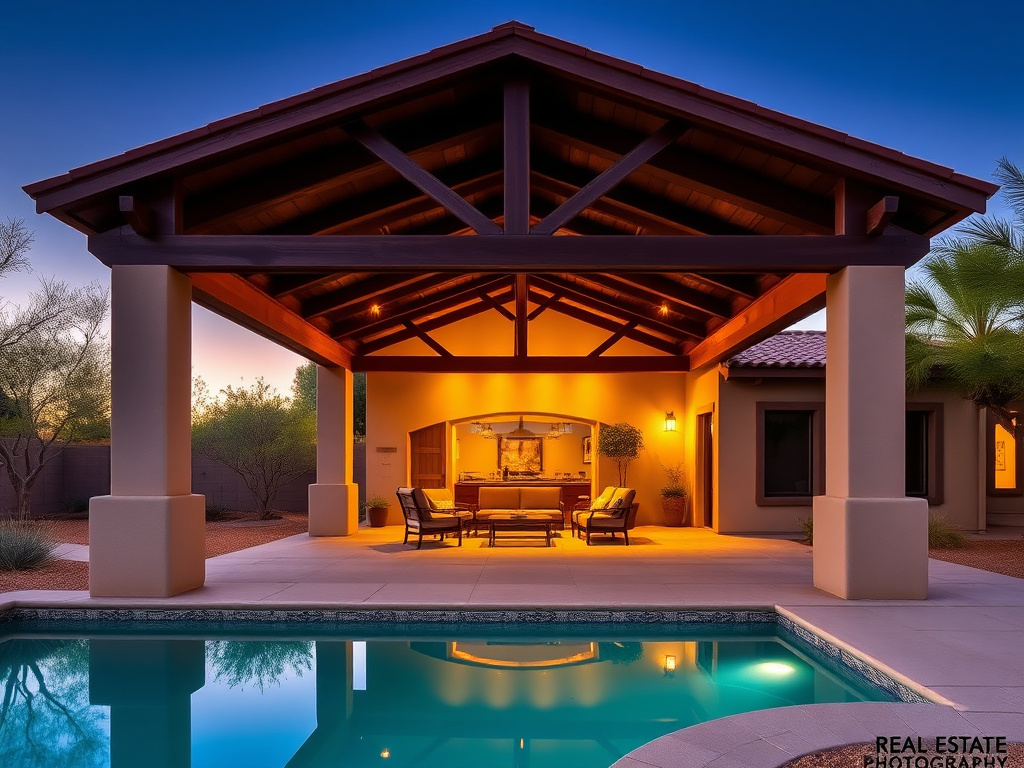
Ramadas & Gazebos in Chandler, AZ — A Solid-Roof Retreat in Your Own Backyard
A ramada is the Southwest's answer to full-time shade: a freestanding, solid-roof shelter that turns any spot in your yard into a cool, finished outdoor room. We design and build ramadas across Chandler, Gilbert, Mesa, Queen Creek, and Tempe, engineered for our heat and monsoon winds. Call 844-967-5247 to plan yours.
What's Included
- Freestanding solid-roof design
- Alumawood, aluminum, or tile-matched roofing
- Engineered footings and post embedment
- Chandler permit and HOA paperwork handled
- Poolside, spa, and fire-pit placement
- Integrated lighting, fans, and outlets
What a ramada is
A ramada is a freestanding, solid-roof shade shelter and a true Southwest classic. Unlike a slatted pergola that filters the sun, a ramada gives you full, all-day shade and a finished ceiling overhead, so the space below stays usably cool even on a 115-degree July afternoon. Think of it as an outdoor room that stands on its own footings anywhere in your yard, sized and finished to feel like it belongs to your home.
Because a ramada is detached from the house, it does not depend on your existing roofline. That freedom is the whole point. You can drop a ramada over a pool deck, a spa, a fire pit, or a seating area on the far side of the yard, wherever the shade actually needs to be rather than only where the home happens to sit.
Ramadas have deep roots in Arizona, and for good reason. The solid roof blocks radiant heat before it ever reaches the people underneath, and a properly built ceiling can be finished, insulated, and wired for lights and fans. Add a ceiling fan and a couple of recessed lights and you have a spot that stays comfortable long after the sun drops behind the block wall. The result is a shaded retreat that feels like an extension of your home, built specifically for how we live outdoors in the desert.
Ramada vs. gazebo vs. freestanding pergola
These three structures get grouped together, but they solve different problems. A ramada is defined by its solid roof and full shade, usually with a squared, architectural profile that matches a home. A gazebo is typically an octagonal or rounded garden structure, more decorative and often smaller. A freestanding pergola has an open or slatted top that filters light rather than blocking it.
- Ramada: solid roof, full shade, finished ceiling, best for pools, kitchens, and true outdoor rooms.
- Gazebo: ornamental garden focal point, often prefab, lighter shade and lighter engineering.
- Freestanding pergola: open or louvered top for filtered shade and airflow, cooler look but partial sun.
If your goal is a shaded space you can actually use through the hottest months, without squinting or hunting for a cool corner, a ramada is almost always the right call. We help East Valley homeowners weigh the trade-offs during a free on-site consultation, matching the structure to how you plan to use the yard rather than pushing one style.
Many of our clients land on a ramada once they realize a pergola alone will not tame the midday sun over a pool or dining area, no matter how tightly the slats are spaced. When you need a finished ceiling and dependable shade that holds up through the hottest part of the day, the solid roof wins, and it does so without the maintenance a wood gazebo would demand in our climate.
Popular uses for a ramada
The most requested ramada in the East Valley goes poolside. A solid roof next to the water gives swimmers a cool place to retreat between dips and keeps chairs, towels, and drinks out of the punishing sun. It transforms a pool deck from a place you dash across into a place you actually linger.
Spas and hot tubs are another natural fit. A ramada overhead adds privacy and shade for daytime soaking and keeps debris out of the water. Fire-pit ramadas extend the season in the other direction, giving you a defined, sheltered gathering spot for the cooler desert evenings from fall through spring. The overhead structure also holds string lights, heaters, and a ceiling fan, so the same spot works whether you are escaping August heat or gathering around flames in January.
By far the most ambitious use is sheltering an outdoor kitchen. A ramada provides the rated roof a built-in cooking and dining setup needs, protecting appliances and cooks alike while keeping the whole space comfortable. We frequently build a ramada and an outdoor kitchen as one coordinated project so the footings, roof, and utility rough-ins all work together from day one. Some homeowners even use a ramada as a detached lounge or reading nook well away from the house, taking advantage of the fact that it can go wherever the best view or the deepest shade happens to be. Whatever the use, the common thread is simple: homeowners want a real shaded room out in the yard, and a ramada delivers it.
Materials and roof styles
For the desert we build ramadas in the materials that actually last here: powder-coated aluminum, Alumawood, and steel. These do not absorb moisture, so they will not warp, crack, rot, or rust through the swing between bone-dry summer heat and monsoon humidity, and quality powder coating resists UV fade for decades. Wood looks handsome on day one but needs re-staining every two to three years under our sun, which is why most East Valley homeowners skip it for a permanent structure.
Alumawood is a popular ramada roof because the panels are hollow and foam-insulated, so the underside runs noticeably cooler than solid metal. For the coolest possible ceiling we can specify insulated roof panels that stop radiant heat before it enters the space. Steel enters the picture when a ramada spans a wide opening or has to carry higher loads, since it lets us reach farther between posts.
Roof style matters for curb appeal too. We can build a flat or gently pitched Alumawood roof, or match your home more closely with a tile or foam-coated roof that mirrors your existing rooflines. Tying the ramada's finish and color to the house is what makes it read as part of the property rather than a bolt-on, and it is often exactly what an HOA architectural committee wants to see. We bring color and texture samples to the consultation so you can hold them against your stucco and fascia before anything is ordered.
Footings, wind engineering, and permitting
Because a ramada stands on its own, its footings are everything. In Chandler, patio-cover and shade-structure posts require a footing that is a minimum of 18 inches square and 12 inches below grade, with rafters sized to the code tables. Those engineered footings are also what keep the structure standing when a monsoon microburst rolls through, and Phoenix microbursts routinely gust 60 to 70 mph or higher. We build every ramada with proper post embedment, footing size, and connections rated for those loads.
Permitting comes with the territory for a detached structure. Freestanding covers over roughly 200 square feet, and any structure with electrical for lights or fans, generally require a City of Chandler building permit, and the city asks you to clear zoning and yard setbacks with a Planner before you submit. We handle all of that for you across Chandler, Gilbert, Mesa, Queen Creek, and Tempe, including engineered, stamped plans where the city requires them and the architectural packet your HOA needs.
On sizing and cost, ramadas price like other solid-roof covers, generally starting around 25 dollars per square foot installed and rising toward 40 dollars per square foot for insulated roofs, plus engineering and permit fees. A common 12-by-16 or 16-by-20 poolside ramada is a great starting footprint, and larger footprints scale up from there depending on how much of the yard you want covered. We give a firm, itemized quote after a free on-site measure, with no guesswork and no surprise line items later. Call 844-967-5247 to get started.
Ramadas & Gazebos — Common Questions
Ready to Design Your Ramadas & Gazebos?
Book a free on-site design consultation — we handle the permits, HOA approval and engineering.